
Encephalocele
What is an encephalocele?
An encephalocele is a rare birth defect in which the tissue covering the brain, and a portion of the brain itself, protrude through openings in the skull. It may be accompanied by other craniofacial defects.
Encephaloceles can occur anywhere in the skull — involving the top, back, or sides of the head, or the forehead, nose, and eye area. Their severity varies, depending on their size, location, and what parts of head and face are involved.
The exact cause of encephalocele is unknown. It a type of neural tube defect, meaning that the neural tube — a narrow channel that should close during early gestation to form the brain and spinal cord — does not close properly.
Symptoms & Causes
What are the symptoms of an encephalocele?
Doctors can see an encephalocele as soon as your baby is born. Sometimes a small encephalocele in the nose and forehead region can go undetected until properly diagnosed. Encephaloceles are often accompanied by craniofacial abnormalities or other brain malformations.
Symptoms of encephalocele that your child may face include:
- Neurologic problems
- Hydrocephalus: Cerebrospinal fluid accumulated in the brain
- Spastic quadriplegia: Paralysis of the limbs
- Microcephaly: An abnormally small head
- Ataxia: Uncoordinated muscle movement
- Developmental delay
- Vision problems
- Mental and growth retardation
- Seizures
Encephalocele can be treated with surgery for further details contact Neuro Associates.
An encephalocele forms when the neural tube does not close properly during gestation. A neural tube is a narrow channel that folds and closes to form the brain and spinal cord. The exact cause, however, is unknown. It usually occurs among families with a history of spina bifida and anencephaly.
Women who are or plan to become pregnant should consume a healthy diet with good sources of vitamin B (folic acid). During pregnancy, an increase in vitamin B may reduce the number of babies born with neural tube defects.
Lipomyelomeningocele
What is a lipomyelomeningocele?
A lipomyelomeningocele (li-PO-my-uh-lo-meh-NIN-guh-seal) is a fatty mass that affects a child’s backbone (spine). It looks like a large lump under the skin. The mass attaches to the spinal cord and may slowly pull on it. The spinal cord can become stuck (tethered), instead of floating freely in the spinal canal. As your child grows, a tethered spinal cord will stretch like a rubber band. If the problem is not treated, it can lead to nerve damage and loss of function, like the ability to walk or control their bladder.
A lipomyelomeningocele may form as the developing baby (embryo) grows early in pregnancy. It is present when a baby is born (congenital).
Women who are or plan to become pregnant should consume a healthy diet with good sources of vitamin B (folic acid). During pregnancy, an increase in vitamin B may reduce the number of babies born with neural tube defects.
What are the symptoms of a lipomyelomeningocele?
In most babies, a lipomyelomeningocele looks like a large lump under the skin, usually in the middle of the back. But sometimes, there is no lump or other mark on a baby’s back.
All babies with a lipomyelomeningocele have a spinal cord that is stuck (tethered) into the fatty mass on their back. This may pull the spinal cord down. Tethered spinal cord can cause symptoms, such as:
- Back and leg pain
- Weak and numb legs
- Changes in bladder and bowel control
- Frequent falls
- In-turning of the feet or orthopedic deformities
How is a lipomyelomeningocele diagnosed?
Sometimes doctors detect the condition before birth during routine pregnancy tests. If so, specialists at our Neuro Associates will assess your baby’s health to prepare for their birth and care.
Usually, doctors can see a lipomyelomeningocele when a baby is born. They may see a lump or some other type of mark on your baby’s back, such as a fat pad, birthmark, dimple or tuft of hair.
We will use MRI (magnetic resonance imaging) to get a better view of your baby’s spinal cord and any problems.
Sometimes, there is no outward sign of a lipomyelomeningocele, and it causes no symptoms. These children may be diagnosed later in life if symptoms start or if an MRI scan done for some other reason shows the lipomyelomeningocele.
How is a lipomyelomeningocele treated?
Most babies with a lipomyelomeningocele have surgery before age 1.
During surgery:
- First, your child’s neurosurgeon removes parts of some bones (vertebrae) in your child’s spine. This procedure (called laminectomy) provides access to the spinal cord or spinal nerve roots that need repair.
- We use advanced neuromonitoring to make your child’s surgery as safe as possible.
- Next, the neurosurgeon removes some of the fatty mass to free the spinal cord. The surgeon uses a laser for increased precision and to reduce bleeding and scarring.
- Then the neurosurgeon and a plastic surgeon close the hole where the fatty mass enters the spinal canal. They use the coverings of the spinal cord (dura) to close the defect.
Even after surgery to repair a lipomyelomeningocele, there is a chance the cord will attach again as your child grows.
Myelomeningocele
Myelomeningocele is a type of spina bifida. This is when the neural tube has failed to close and the neural tissue is exposed on the baby’s back. The myelomeningocele will look like a sac sticking out from a baby’s back.
In early development, the brain and spinal cord start as a tube-like structure called the ‘neural tube’ that is open at either end. These openings close within the first weeks of pregnancy, and the neural tube continues to grow and fold, eventually forming the brain and spinal cord.
If the tube fails to close properly, this results in a group of problems called ‘neural tube defects’. There are two types of neural tube defect: open, also called spina bifida aperta or myelomeningocele, or closed, also called spina bifida occulta.
This information explains about the open myelomeningocele type, which accounts for 75 per cent of all cases of spina bifida.
In myelomeningocele, the neural tube has failed to close and the neural tissue is exposed at a place on the baby’s back called the ‘neural placode’. This most commonly happens in the baby’s lower back just above the bottom, but could occur anywhere along the spine. The myelomeningocele will look like a sac sticking out from the baby’s back.
How is myelomeningocele treated?
Without the protective covering of skin, the spinal cord will become further damaged, spinal fluid often leaks from the area and there is a very high risk of infection. Surgery is usually recommended within the first few days of life.
The aim of surgery at this stage is to put the spinal cord back into the spinal canal and repair the defect in the back so that the area is covered with normal, healthy skin.
Before surgery, the affected area is covered with a dressing and the baby will be nursed on their front. A number of specialists will visit to examine the baby, including a neurosurgeon, physiotherapist, paediatrician, orthopaedic surgeon and anaesthetist.
Craniosynostosis
What is Craniosynostosis?
Craniosynostosis, or simply synostosis, is the early growing together (or fusion) of two or more bones of the skull.
What is Craniosynostosis Head Shape?
The main symptom of craniosynostosis is an abnormal head shape. An abnormal head shape (plagio
What is Craniosynostosis Head Shape?
The main symptom of craniosynostosis is an abnormal head shape. An abnormal head shape (plagiocephaly) can happen when forces push on the skull before or after birth. This can happen before birth:
When the baby descends into the pelvis
If the mom has an abnormally shaped uterus
If the fetus is in an odd position
If the mom is having more than one baby (like twins or triplets)
After birth, abnormal head shape is most commonly a result of gravity. This can happen when the baby lies in one position for long periods of time.
cephaly) can happen when forces push on the skull before or after birth. This can happen before birth:
- When the baby descends into the pelvis
- If the mom has an abnormally shaped uterus
- If the fetus is in an odd position
- If the mom is having more than one baby (like twins or triplets)
After birth, abnormal head shape is most commonly a result of gravity. This can happen when the baby lies in one position for long periods of time.
Tethered Spinal Cord
What is a tethered spinal cord?
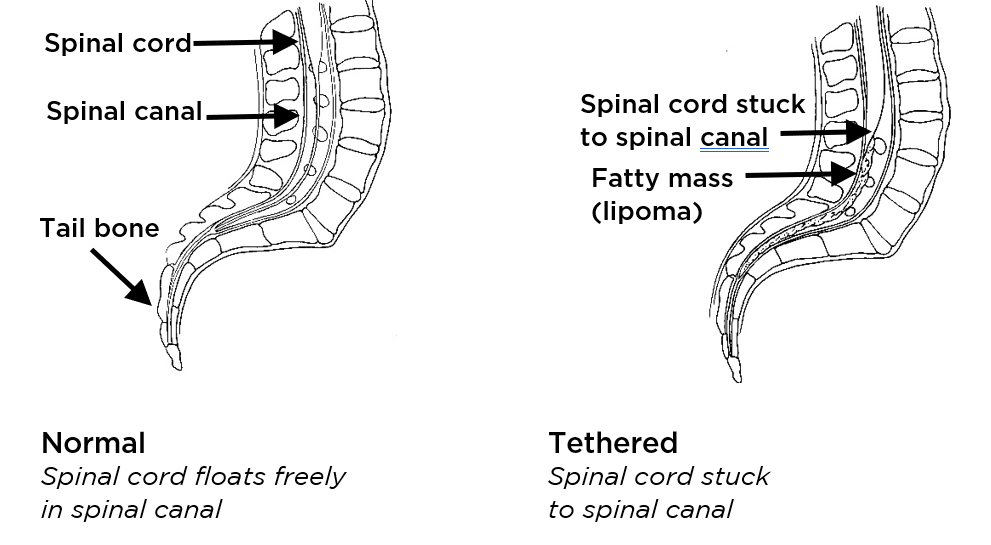
Normally, the spinal cord floats freely inside a tube in the spine called the spinal canal. A tethered spinal cord is pulled down and stuck to the inside of the spinal canal.
As a child grows, a tethered spinal cord will stretch like a rubber band. If the problem is not treated, it can cause lasting damage to a child’s spinal nerves. This can lead to loss of function, like the ability to walk or control their bladder.
Tethered spinal cord most often happens in children who are born with problems affecting the spinal cord, such as:
- A small sac sticks through an opening in the spine (myelomeningocele). This is the most serious form of spina bifida.
- A fatty mass is attached to the spinal cord (lipomyelomeningocele).
- The very end of their spinal cord is held down too tightly because the flexible fiber connecting it to the bottom bones of the spine is thicker than normal (fatty filum).
In a child born with such a condition, their spinal cord may become stuck, or tethered, to the fatty filum, myelomeningocele or lipomyelomeningocele. This pulls on the spinal cord as the child grows, causing symptoms.
A child also may have a tethered spinal cord because:
- They have a small abnormal channel from their skin into their spinal canal (dermal sinus tract)
- Their spinal cord is split into 2 cords near the end (diastematomyelia)
How is tethered spinal cord diagnosed?
We bring together experts in Neuro Associates diagnose your child.
Our doctors:
Examine your child, looking for signs and symptoms
Use MRI (magnetic resonance imaging) to take high-quality pictures inside your child’s body to help us assess your child’s condition
Hydrocephalus
Hydrocephalus in babies is the abnormal buildup of cerebrospinal fluid in the brain’s ventricles, causing increased pressure and, often, a rapidly enlarging head. Common signs include a bulging “soft spot” (fontanelle), irritability, vomiting, sleepiness, and downward-looking eyes. While not curable, it is manageable with early surgical treatment—usually a shunt—allowing many children to live normal lives.
- Rapid Head Growth: Noticeable enlargement of the head circumference.
- Fontanelle Changes: The soft spot on top of the head may be tense, bulging, or swollen.
- “Sunset” Eyes: Eyes that appear to look constantly downward.
- Behavioral/Physical: Extreme irritability, excessive sleepiness, poor feeding, and frequent vomiting.
- Scalp Veins: Veins on the scalp may appear dilated or engorged.
- Congenital: Present at birth due to genetic issues or infections during pregnancy, such as toxoplasmosis, rubella, or mumps.
- Acquired: Develops after birth due to infection (meningitis), brain tumors, or premature birth bleeding.
- Diagnosis: Often detected via prenatal ultrasound or confirmed after birth using MRI, CT scans, or ultrasounds.
- Shunt: A surgical procedure that places a tube to drain excess fluid from the brain to another part of the body, usually the abdomen.
- Endoscopic Third Ventriculostomy (ETV): A procedure where a small hole is made in the floor of the third ventricle to allow fluid to bypass the blockage.
- Prognosis: While there is no cure, timely intervention can prevent further brain damage and allow for normal development, though long-term monitoring by specialists is required.
If you notice rapid head growth or symptoms like excessive vomiting or irritability, immediate consultation with a pediatrician or pediatric neurosurgeon
Diagnosis & Treatment
Research and analytics
How we address encephaloceles.
For More Info
Make an appointment
For an appointment with the Neuro Associates more information or to obtain a second opinion for your child, please call us at +92 333 4612694
Services Category
Our Brochures
Lipomyelomeningocele
What is a lipomyelomeningocele?
A lipomyelomeningocele (li-PO-my-uh-lo-meh-NIN-guh-seal) is a fatty mass that affects a child’s backbone (spine). It looks like a large lump under the skin. The mass attaches to the spinal cord and may slowly pull on it. The spinal cord can become stuck (tethered), instead of floating freely in the spinal canal. As your child grows, a tethered spinal cord will stretch like a rubber band. If the problem is not treated, it can lead to nerve damage and loss of function, like the ability to walk or control their bladder.
A lipomyelomeningocele may form as the developing baby (embryo) grows early in pregnancy. It is present when a baby is born (congenital).
Women who are or plan to become pregnant should consume a healthy diet with good sources of vitamin B (folic acid). During pregnancy, an increase in vitamin B may reduce the number of babies born with neural tube defects.
